

Tax brackets in Canada are determined by your income and dictate how much tax you'll pay on that income. It's a tiered system, meaning that once you move into a higher tax bracket, you’re only taxed at the higher rate on the portion of your income that falls within that bracket.
Knowing how tax brackets work can help you predict your tax obligations and identify any mistakes. Below are the 2025 federal and provincial tax brackets, along with an example to guide you in calculating your own tax rate.
Key Takeaways
- Tax brackets indicate how much each section of your income is taxed every year.
- You'll be taxed at both the provincial and federal level, which each have different tax rates and income segments.
- Only the amount of your income that goes over a certain bracket will be taxed at the new rate.
- The federal tax rates for 2025 range from 15% to 33%.
Federal Canada tax brackets 2025
Federal income tax brackets are fairly straightforward – the higher your income, the higher your tax rate is. And the opposite is also true – the lower your income, the lower your tax rate will be.
Because Canada uses progressive tax rates, once you reach a higher income bracket, only the portion of your income that falls into that bracket is taxed at the higher rate.
Even if you make enough to reach the top tax bracket, your total income would be split up into 5 different parts, and you would pay a certain tax rate on each section. So the first $55,867 you make will still only be taxed at 15%, no matter how much you earn.
The table below is a general guide outlining the tax rates for each bracket.
| Tax bracket | Maximum amount taxable in this bracket | Tax rate | Maximum tax paid in the bracket |
|---|---|---|---|
| Up to $57,375 | $57,375 | 15% | $8,606.25 |
| $57,376 – $114,750 | $57,375 | 20.5% | $11,761.88 |
| $114,751 – $177,882 | $63,132 | 26% | $15,982.72 |
| $177,883 – $253,414 | $75,532 | 29% | $21,904.28 |
| $253,415 and up | No maximum | 33% | No maximum |
For some handy tax calculators straight from the government, see Income tax rates for individuals.
Though marginal tax rates seem pretty simple, sometimes it can be easy to get lost in the details when looking at a chart. So let's go over an example of someone who makes $516,512 (wouldn't that be nice), which would put you in the top tax bracket in Canada. Keep in mind these numbers are for 2024.
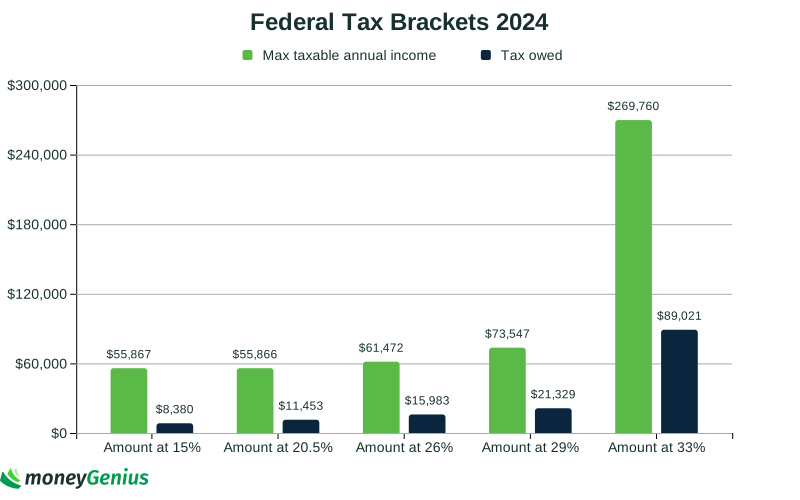
But just using this table doesn't necessarily give you the full story – mostly because it doesn't account for things like tax credits, capital gains, and many other factors that can easily get your head swimming.
For example, you’ll need to determine your basic personal amount, which is a tax credit that's available to everyone and determines how much of your income isn't subject to taxes. For 2025, the personal federal exemption is $14,538 for people with a net income up to $253,414.
Tip: Income tax software (like TurboTax) calculates the amount of taxes you owe using marginal tax rates. TurboTax even has a handy estimator that lets you quickly enter an amount to get an idea of how much taxes you'll pay based on the type of income and what province you live in.
Provincial tax brackets in Canada 2025
Along with federal taxes, you also need to pay provincial/territorial taxes, which may differ slightly depending on where you live.
In general, you'll be required to pay taxes in the province you reside on December 31st of that tax year. If you live in one province but earn income in another, you'll still file your return based on your residency status (where you live instead of where you earn your income).
Below is a breakdown of the tax brackets and rates in each province, plus the maximum taxes paid within each bracket.
Let's get started.
- Alberta
- British Columbia
- Manitoba
- New Brunswick
- Newfoundland and Labrador
- Northwest Territories
- Nova Scotia
- Nunavut
- Ontario
- Prince Edward Island
- Quebec
- Saskatchewan
- Yukon
Alberta tax brackets
Below are the current tax brackets for Alberta.
| Tax bracket | Maximum amount taxable in this bracket | Tax rate | Maximum tax paid in the bracket |
|---|---|---|---|
| Up to $151,234 | $151,234 | 10% | $15,123.40 |
| $151,235 – $181,481 | $30,247 | 12% | $3,629.64 |
| $181,482 – $241,974 | $60,493 | 13% | $7,864.09 |
| $241,975 – $362,961 | $120,987 | 14% | $16,938.18 |
| $362,962 and up | No maximum | 15% | No maximum |
British Columbia tax brackets
Below are the current tax brackets for British Columbia.
| Tax bracket | Maximum amount taxable in this bracket | Tax rate | Maximum tax paid in the bracket |
|---|---|---|---|
| Up to $49,279 | $49,279 | 5.06% | $2,493.50 |
| $49,280 – $98,560 | $49,281 | 7.7% | $3,794,60 |
| $98,561 – $113,158 | $14,598 | 10.5% | $1,532.79 |
| $113,159 – $137,407 | $24,249 | 12.29% | $2,980.20 |
| $137,408 – $186,306 | $48,899 | 14.7% | $7,188.15 |
| $186,307 – $259,829 | $73,523 | 16.8% | $12,351.86 |
| $259,830 and up | No maximum | 20.5% | No maximum |
Manitoba tax brackets
Here's a look at the current Manitoba tax brackets.
| Tax bracket | Maximum amount taxable in this bracket | Tax rate | Maximum tax paid in the bracket |
|---|---|---|---|
| Up to $47,564 | $47,564 | 10.8% | $5,136.91 |
| $47,565 – $101,200 | $53,636 | 12.75% | $6,838.59 |
| $101,201 and up | No maximum | 17.4% | No maximum |
New Brunswick tax brackets
Below are the current tax brackets for New Brunswick.
| Tax bracket | Maximum amount taxable in this bracket | Tax rate | Maximum tax paid in the bracket |
|---|---|---|---|
| Up to $51,306 | $51,306 | 9.4% | $4,822.76 |
| $51,307 – $102,614 | $51,308 | 14% | $7,183.12 |
| $102,615 – $190,060 | $87,446 | 16% | $13,991.36 |
| $190,061 and up | No maximum | 19.5% | No maximum |
Newfoundland and Labrador tax brackets
Below are the current tax brackets for Newfoundland and Labrador.
| Tax bracket | Maximum amount taxable in this bracket | Tax rate | Maximum tax paid in the bracket |
|---|---|---|---|
| Up to $44,192 | $44,192 | 8.7% | $3,844.70 |
| $44,192 – $88,382 | $44,190 | 14.5% | $6,407.55 |
| $88,383 – $157,792 | $69,410 | 15.8% | $10,966.78 |
| $15,7793 – $220,910 | $63,118 | 17.8% | $11,235.00 |
| $220,911 – $282,214 | $61,304 | 19.8% | $12,138.19 |
| $282,215 – $564,429 | $282,215 | 20.8% | $58,700.72 |
| $564,429 – $1,128,858 | $564,429 | 21.3% | $120,223.38 |
| $1,128,859 and up | No maximum | 21.8% | No maximum |
Northwest Territories tax brackets
Below are the current tax brackets for Northwest Territories.
| Tax bracket | Maximum amount taxable in this bracket | Tax rate | Maximum tax paid in the bracket |
|---|---|---|---|
| Up to $51,964 | $51,964 | 5.9% | $3,065.88 |
| $51,965 – $103,930 | $51,966 | 8.6% | $4,469.08 |
| $103,931 – $168,967 | $65,037 | 12.2% | $7,934.51 |
| $168,967 and up | No maximum | 14.05% | No maximum |
Nunavut tax brackets
Below are the current tax brackets for Nunavut.
| Tax bracket | Maximum amount taxable in this bracket | Tax rate | Maximum tax paid in the bracket |
|---|---|---|---|
| Up to $54,707 | $54,707 | 4% | $2,188.28 |
| $54,708 – $109,413 | $54,706 | 7% | $3,829.42 |
| $109,414 – $177,881 | $68,468 | 9% | $6,162.12 |
| $177,882 and up | No maximum | 11.5% | No maximum |
Nova Scotia tax brackets
Below are the current tax brackets for Nova Scotia.
| Tax bracket | Maximum amount taxable in this bracket | Tax rate | Maximum tax paid in the bracket |
|---|---|---|---|
| Up to $30,507 | $30,507 | 8.79% | $2,681.57 |
| $30,508 – $61,015 | $30,508 | 14.95% | $4,560.95 |
| $61,016 – $95,883 | $34,868 | 16.67% | $5,812.50 |
| $95,884 – $154,650 | $58,767 | 17.5% | $10,284.23 |
| $154,651 and up | No maximum | 21% | No maximum |
Ontario tax brackets
Below are the current tax brackets for Ontario.
| Tax bracket | Maximum amount taxable in this bracket | Tax rate | Maximum tax paid in the bracket |
|---|---|---|---|
| Up to $52,886 | $52,886 | 5.05% | $2,670.74 |
| $52,887 – $105,775 | $52,889 | 9.15% | $4,839.34 |
| $105,776 – $150,000 | $44,225 | 11.16% | $4,935.51 |
| $150,001 – $220,000 | $70,000 | 12.16% | $8,512.00 |
| $220,001 and up | No maximum | 13.16% | No maximum |
Prince Edward Island tax brackets
Below are the current tax brackets for Prince Edward Island.
| Tax bracket | Maximum amount taxable in this bracket | Tax rate | Maximum tax paid in the bracket |
|---|---|---|---|
| Up to $31,984 | $31,984 | 9.8% | $3,134.43 |
| $31,985 – $63,969 | $31,985 | 13.8% | $4,413.93 |
| $63,970 and up | No maximum | 16.7% | No maximum |
Quebec tax brackets
Below are the current tax brackets for Quebec.
| Tax bracket | Maximum amount taxable in this bracket | Tax rate | Maximum tax paid in the bracket |
|---|---|---|---|
| Up to $53,255 | $53,255 | 14% | $7,455.70 |
| $53,256 – $106,495 | $53,240 | 19% | $10,115.60 |
| $106,496 – $129,590 | $23,095 | 24% | $5,542.80 |
| $129,591 and up | No maximum | 25.75% | No maximum |
Saskatchewan tax brackets
Below are the current tax brackets for Saskatchewan.
| Tax bracket | Maximum amount taxable in this bracket | Tax rate | Maximum tax paid in the bracket |
|---|---|---|---|
| Up to $53,463 | $53,463 | 10.5% | $5,313.62 |
| $53,464 – $152,750 | $99,287 | 12.5% | $12,410.88 |
| $152,751 and up | No maximum | 14.5% | No maximum |
Yukon tax brackets
Below are the current tax brackets for Yukon.
| Tax bracket | Maximum amount taxable in this bracket | Tax rate | Maximum tax paid in the bracket |
|---|---|---|---|
| Up to $57,375 | $57,375 | 6.4% | $3,672.00 |
| $57,376 – $114,750 | $57,375 | 9% | $5,163.75 |
| $114,751 – $177,882 | $63,132 | 10.9% | $6,881.39 |
| $177,883 – $500,000 | $322,118 | 12.8% | $41,231.10 |
| $500,001 and up | No maximum | 15% | No maximum |
What are tax brackets?
In order to better understand how taxes work, let's define a couple of terms.
- Tax brackets are "buckets" that taxable income falls into. The higher the income, the bigger the bucket is.
- The tax bracket rate is how much tax you pay for that level of income. The higher your income, the higher your tax bracket rate will be.
- A marginal tax rate is the tax rate you pay on your next $1 of income. The higher your income, the higher the marginal rate will be.
In simple terms, Canada's progressive tax system is created so that lower income earners are taxed at a lower rate and higher income earners pay taxes at a higher rate.
How to calculate your tax rate: An example scenario
As an example, if someone had $25,000 of taxable income in Alberta in 2024 they'd pay just under $2,000 in taxes.
Why? Let's dig deeper.
For federal they'd pay:
$25,000 - $15,705 basic exemption = $9,295 taxable at 15% = $1,394.25
And for provincial taxes, they'd pay:
$25,000 - $21,885 basic exemption = $3,115 taxable at 10% = $311.50.
Combined, that means they'd pay a total of $1,705.75 in taxes ($1,394.25 federal and $311.50 provincial).
For a quick calculator on calculating the taxes for your own situation, see 2024 personal tax calculator.
Are you a (nervous) first-time tax filer? Here's everything you need to know about your first time filing your income taxes by yourself.
How provincial income tax works for remote workers
With the increase in remote work, it's become much more likely that your company is based in a different province than the one you live in. In this case, your paycheques may be taxed at a different rate than you'll owe at the end of the year, which could result in large tax returns or tax owings.
For example, if your company is based in a province with high tax rates, but you live in a province with low tax rates, you may be taxed more than you need to be on your paycheques, which you'll get back at income tax time.
But the opposite could also be true, where you may end up owing more than you've been paying on each paycheque. So you may want to prepare for a larger-than-anticipated tax owing by contributing to a savings account.
FAQ
What are tax brackets?
A tax bracket is a range of income that's taxed at a certain rate. Generally the higher the income, the higher the tax rate will be. This calculation can get complicated depending on how much you earn. But the good news is tax software in Canada automatically calculates it for you.
What are the tax brackets in Canada for 2025?
The Canada federal tax brackets are 15% on your first $57,375, 20.5% on anything between $57,375 and $114,750, 26% on anything between $114,750 and $177,882, 29% on anything between $177,882 and $253,414, and 33% on all income above $253,414. You can see the full chart in detail here.
What's the difference between federal and provincial tax brackets?
Federal tax brackets apply to all Canadians, whereas provincial tax brackets only apply to residents of a certain province. Rates vary between federal and all provinces, and you have to pay both during tax season. The province that you have to pay tax for is usually the one you lived in on December 31st of the tax year.
What's the lowest tax bracket in Canada?
For provinces and territories, Nunavut has the lowest tax bracket rate at 4% for income below $54,707.
What's the highest tax bracket in Canada?
For provinces and territories, Quebec has the highest tax bracket at 25.75% for income above $129,591.
Can I move to a lower tax bracket?
Yes, there are ways to reduce your taxable income through tax deductions. A popular way to do this is through an RRSP. When you contribute money to an RRSP, funds can be claimed as a deduction from your total income.













































Leave a comment
Comments