


The top ETF provider is Scotiabank, and some of the other top-performing ETFs to keep an eye on include XEQT, XGRO, VFV, and XAW. The best ETF choices have a diverse mix of securities that help reduce risk but still have substantial growth potential.
An ETF is a type of investment that consists of a basket of smaller investments, like stocks and bonds. They offer a simple and affordable way to grow your money over time, making them popular with both beginner and seasoned investors.
Here's a look at some of the best-performing ETFs available in Canada, trends to watch in ETF investing, and more.
Key Takeaways
- The best ETF provider in Canada is Scotiabank, thanks to its wide range of index tracker and responsible investing ETFs.
- XEQT, XGRO, VFV, and XAW are a few top ETF choices for Canadian investors.
- Current trends show that investors are interested in ESG factors and thematic investing.
- Investing in ETFs provides an easy way to diversify your portfolio for a reasonable price.
- Unfortunately, actively managed ETFs come at a higher cost than other types.
Best ETF provider in Canada 2026 winner: Scotiabank ETFs

# Of ETFs
200
Min Management Fee
0.03%
Max Management Fee
0.17%
Scotiabank offers a small collection of Exchange Traded Funds (ETFs) – bundles of securities that are listed on exchanges, which are traded just like regular stocks. Scotiabank has over 120 ETFs available, and you can use them to diversify your investment portfolio.
Pros
- Competitive ETF management fees
- Simple investing through Scotia iTRADE
- Investment education resources and tools
- Access to personalized advice
Cons
- Scotia iTRADE fees
Provinces
See Issuer for Details
Eligibility
See Issuer for Details
Why You Want It
Fees starting as low as 0.03% + Work with Scotia investment specialists.
Special Features
- Free investing education resource library
- Access to Scotiabank investment specialists
Types Of ETFs
- Fixed Income
- Canadian Equity
- U.S. Equity
- International Equity
- Index Tracker
# Of ETFs
200
Min Management Fee
0.03%
Max Management Fee
0.17%
Min MER
0.06%
Max MER
0.25%
Personalized Advice?

Self-directed Investing Platform Available?
Our pick for the best ETF provider in Canada for 2026 is Scotiabank ETFs. With a wide range of index tracker and responsible investing ETFs, users can build diversified and cost-effective portfolios that cover various sectors, asset classes, and global markets.
Scotiabank ETFs are flexible, allowing you to tailor them to your unique financial needs. They have low management fees and consistent, solid performance, providing an efficient way for new and experienced investors to gain exposure to key markets with minimal risk.
Methodology
To evaluate ETFs, we analyze over 10 data points to generate a trustworthy Genius Rating. We consider all aspects of an ETF, including types of ETFs on offer, perks, management fees, customer satisfaction, and access to personalized advice, to assess its overall value. Then, the ETF’s features are rated based on how they stack up against other available options.
10 top Canadian ETFs at a glance
If you're looking for the best individual ETFs to buy, these are the funds to take a look at:
| ETF name | Best for | Fees | Asset class | 1-year average annual return* | Average annual return since inception* (inception date) |
|---|---|---|---|---|---|
| iShares Core Equity ETF Portfolio - XEQT | Broad diversification across regions | * Management fee: 0.18% * MER: 0.2% | * Multi-asset * 99.71% equities * 0.29% Cash and/or derivatives | 15.51% | 12.08% (August 7, 2019) |
| Vanguard All-Equity ETF Portfolio - VEQT | Direct and indirect equity securities investments | * Management fee: 0.22% * MER: 0.24% | * Multi-asset * 0.02% short term reserves * 99.98% stocks | 15.72% | 11.9% (January 29, 2019) |
| iShares Canadian Growth Index ETF - XCG | Exposure to large and mid-sized Canadian companies | * Management fee: 0.5% * MER: 0.55% | * Multi-asset *Heavily weighted to Canadian equities | 21.69% | 7.27% (November 6, 2006) |
| iShares Core Growth ETF Portfolio - XGRO | Diverse regions and asset classes | * Management fee: 0.18% * MER: 0.2% | * Equity * 81.82% equities * 18.07% fixed income * 0.11% cash and/or derivatives | 13.78% | 5.19% (June 21, 2007) |
| iShares S&P TSX Capped REIT Index ETF - XRE | Exposure to Canadian REITs | * Management fee: 0.55% * MER: 0.61% | * Real estate investment trust equities, mostly retail | 11.65% | 7.87 (October 20, 2011) |
| Vanguard Growth ETF Portfolio - VGRO | All-in-one investments | * Management fee: 0.22% * MER: 0.24% | * Multi-Asset * 80.54% equities * 19.40% Bonds | 13.71% | 8.09% (January 25, 2018) |
| Vanguard S&lP 500 Index ETF - VFV | US equities | * Management fee: 0.08% * MER: 0.09% | * S&P 500 * Equities * Some real estate | 13.78% | 16.66% (November 2, 2012) |
| BlackRock - iShares Core S&P US Total Market Index - XUU | US equities (runner-up) | * Management fee: 0.07% * MER: 0.07% | * USA equities * Small to large companies | 13.54% | 12.83% (February 10, 2015) |
| Vanguard FTSE Canada All Cap Index ETF - VCN | Canadian exposure (runner-up) | * Management fee: 0.05% * MER: 0.05% | * Canada equities large and small | 21.63% | 9.49% (August 2, 2013) |
| BlackRock - iShares Core MSCI All Country World ex Canada Index ETF - XAW | Global equities | * Management fee: 0.2% * MER: 0.22% | * Global All Cap equities, excluding Canada | 12.63% | 10.11% (February 10, 2015) |
* It's important to note that returns can change dramatically from day to day, so it's best to check real-time stats for the most up-to-date information. These returns are included here for illustrative purposes only. All numbers were gathered on June 26, 2025.
1. Best ETF in Canada for broad diversification across regions: XEQT
- Average annual growth: 15.51%
- YTD performance: Up 5.41%
- Number of holdings: 5
- Return since inception: 12.08%
- Current price (April 28, 2025): $35.06
With low fees and continuous monitoring and rebalancing, XEQT is an all-in-one, globally diversified equity ETF designed for long-term growth. It holds a mix of U.S., Canadian, international, and emerging market stocks, offering broad exposure with a 100% equity allocation.
Its low MER makes it a cost-effective option for hands-off investors seeking diversified growth. XEQT is ideal for those with a long investment horizon who can tolerate market fluctuations.
2. Best ETF in Canada for direct and indirect equity securities investments: VEQT
- Average annual growth: 15.72%
- YTD performance: Up 2.2%
- Number of holdings: 8
- Return since inception: 11.9%
- Current price (April 28, 2025): $47.34
VEQT is a 100% equity ETF providing broad diversification across Canadian, U.S., international, and emerging market stocks. It’s designed for long-term investors seeking growth with no fixed-income exposure.
Thanks in part to its low MER (0.24%), VEQT is a cost-effective, automatically balanced, hands-off investment – ideal for those with a high risk tolerance and long investment horizon.
3. Best ETF in Canada for exposure to large and mid-sized Canadian companies: XCG
- Average annual growth: 21.69%
- YTD performance: Up 8.03%
- Number of holdings: 35
- Return since inception: 7.27%
- Current price (April 28, 2025): $59.83
XCG focuses on large and mid-cap Canadian companies with strong growth potential. It tracks the S&P/TSX Composite Growth Index, providing exposure to sectors like technology, financials, and consumer goods. Although it's a bit pricier than broad-market ETFs (MER of 0.55%), it targets companies poised for higher returns.
This ETF is a solid choice for investors looking to capitalize on Canada's growth-oriented stocks while staying diversified within the domestic market. It suits those with higher risk tolerances and long-term investment outlooks.
4. Best ETF in Canada for diverse regions and asset classes: XGRO
- Average annual growth: 13.78%
- YTD performance: Up 4.67%
- Number of holdings: 8
- Return since inception: 5.19%
- Current price (April 28, 2025): $31.39
This balanced, all-in-one ETF is designed for long-term growth. XGRO's holdings mix 80% equity with 20% fixed income, providing global diversification across stocks and bonds.
XGRO is a cost-effective way to invest in a moderate-risk portfolio that balances growth potential with some stability. It offers automatic rebalancing, making it a great hands-off investment for long-term wealth building.
5. Best ETF in Canada for exposure to Canadian REITs: XRE
- Average annual growth: 11.65%
- YTD performance: Up 6.17%
- Number of holdings: 16
- Return since inception: 7.87%
- Current price (April 28, 2025): $15.42
XRE tracks the S&P/TSX Capped REIT Index, investing in income-generating properties across sectors like residential, commercial, and industrial real estate. With a management expense ratio (MER) of 0.61%, this ETF offers a steady income stream through dividends while also providing potential for capital appreciation.
XRE is a valuable investment option for those seeking passive income, diversification, and inflation protection. If you want to add real estate exposure to your portfolio without the headache and responsibility that comes with owning physical properties, XRE is an excellent alternative.
6. Best ETF in Canada for all-in-one investments: VGRO
- Average annual growth: 13.71%
- YTD performance: Up 2%
- Number of holdings: 9
- Return since inception: 8.09%
- Current price (April 28, 2025): $38.76
A diversified, all-in-one ETF designed for long-term growth, VGRO provides global exposure to stocks and bonds through a mix of 80% equity and 20% fixed-income holdings. It has a low MER of 0.24%, providing a cost-effective, hands-off approach to investing.
VGRO is ideal for investors seeking higher growth potential than a balanced portfolio while maintaining some downside protection through bonds. Automatic rebalancing makes this ETF an excellent choice for a set-it-and-forget-it strategy.
7. Best ETF in Canada for U.S. equities: VFV
- Average annual growth: 13.78%
- YTD performance: Down 3.74%
- Number of holdings: 7
- Return since inception: 16.66%
- Current price (April 28, 2025): $148.63
VFV tracks the S&P 500 Index and provides exposure to 500 of the largest U.S. companies. This includes Apple, Amazon, Tesla, and more, with broad diversification across industries. Its low 0.09% MER makes VFV a cost-effective way to invest in the U.S. market.
This ETF is ideal for long-term investors seeking growth through blue-chip American stocks. Keep in mind that because it’s not currency-hedged, returns can be influenced by the CAD/USD exchange rate. Even so, VFV is a solid core holding for those who want U.S. market exposure in a simple, passive investment.
8. Runner up for best ETF in Canada for US equities: XUU
- Average annual growth: 13.54%
- YTD performance: Down 1.16%
- Number of holdings: 122
- Return since inception: 12.83%
- Current price (April 28, 2025): $61.46
XUU offers broad exposure to the entire U.S. stock market, covering large, mid, small, and micro-cap stocks. By tracking the S&P Total Market Index, this ETF provides greater diversification than an S&P 500 ETF. It also has a reasonable MER of 0.07%, making it a cost-effective way to invest in the U.S. economy.
This ETF is an optimal core holding for U.S. market exposure, especially if you're a long-term investor looking for growth through a well-diversified, passive investment. Remember, though, that it's not currency-hedged so returns can be affected by the CAD/USD exchange rate.
9. Best ETF in Canada for Canadian exposure: VCN
- Average annual growth: 21.63%
- YTD performance: Up 7.06%
- Number of holdings: 164
- Return since inception: 9.49%
- Current price (April 28, 2025): $54.18
With broad exposure to the Canadian stock market, including large, mid, and small-cap companies, VCN tracks the FTSE Canada All Cap Index and offers diversification across various sectors. It's a cost-effective (MER of just 0.05%), passive investment for those looking to invest in the Canadian economy.
VCN is ideal for long-term investors who want domestic market exposure through a simple, diversified approach. It can be a core holding for Canadian portfolios or used alongside U.S. and international ETFs to maintain a global balance.
10. Best ETF in Canada for global equities: XAW
- Average annual growth: 12.63%
- YTD performance: Up 2.81%
- Number of holdings: 6
- Return since inception: 10.11%
- Current price (April 28, 2025): $45.67
XAW offers global diversification by investing in U.S., international, and emerging market stocks – excluding Canada. It tracks the MSCI ACWI ex Canada IMI which makes it well suited to complement Canadian-focused investments. With a reasonable MER of 0.22%, XAW is a cost-effective way to access global markets through a single ETF.
This ETF is ideal for investors looking to diversify beyond Canada and gain exposure to the world’s largest economies. XAQ isn't currency-hedged, so be aware that returns can be influenced by foreign exchange fluctuations.
Current ETF trends to watch
Investors know that there are always trends to watch for, and here are a few making waves in the ETF markets right now:
- Emphasis on environmental, social, and governance factors (ESG) increases as more investors prioritize sustainable investment choices.
- Thematic investing ETFs continue to be popular, especially those centred on emerging technologies and global megatrends.
- Quality and cost continue to be top concerns among investors.
- Changes in bond trading practices are making ETFs a more efficient way to access the market.
- Actively managed ETFs are growing in popularity and are poised to capture market share from mutual funds.
- Economic strife is impacting the value of many ETFs, driving prices down.
Why consider investing in ETFs?
ETFs are an easy, low-cost way to build a well-diversified investment portfolio. This makes ETFs a solid option for both new and experienced Canadian investors.
- Low fees: Compared to mutual funds, ETFs usually have lower management fees.
- Flexibility: You can buy or sell ETFs easily if the stock market changes (or your investment goals change).
- Cover your bases: ETFs include a selection of assets, so you’re spreading out your risk.
- Tax benefits: ETFs have fewer taxable events than mutual funds, so this could help reduce your tax burden as an investor.
ETFs can be a great way to start investing while keeping more of your money in the long term.
The pros and cons of ETFs in Canada
There are numerous advantages that come with ETFs, from diversification to cost-effectiveness. Understanding the benefits of this investment choice can help you understand why they've gained popularity among investors of all backgrounds.
Understanding the drawbacks of ETFs can help you make informed decisions when incorporating them into your investment strategy.
| Pros | Cons |
|---|---|
|
|
How to invest in ETFs
There are three main avenues to take if you want to invest in ETFs in Canada:
- Using an online broker: Open an account, add funds, and purchase ETFs directly.
- Using a robo advisor: Open an account, add funds, and let it automatically invest your money in an ETF-based portfolio.
- Working with a financial advisor: Choose an advisor, discuss your wishes and preferences, and purchase the ETFs they recommend.
There isn't a one-size-fits-all option here. You simply have to find the one that best suits your tastes.
If you are interested in taking the online broker approach, consider using TD Direct Investing. There's no minimum amount required to start investing, and you'll have access to a variety of trading and investment platforms, free investment tools, and the latest market research.

Minimum Investment
$0
Maximum Stock Fee
N/A
Maximum ETF Fee
See Issuer for Details
Account Maintence Fees
$25
Like all of the Big 5 Banks, TD offers convenient online investing tools that regular people (not just professional traders) can use to manage their own investments. The TD Direct Investing Platform has high per trade fees, but does offer some pretty interesting educational materials and opportunities to help new and advanced investors.
Pros
- No minimum investment needed to open an account
- Some transfer fees may be reimbursed
- Active trader discount
- Variety of trading and investing platforms
- Wide array of free tools and market research
- Cash back offer
Cons
- High fees per trade can add up fast
- $25 per quarter inactivity fees
- No practice accounts
- No way to automate certain account activities
Provinces
ALL
Eligibility
See Issuer for Details
Why You Want It
Access free resources and tools + Variety of trading platforms.
Special Features
- Video series to learn about investing
- Daily live, interactive Master Class workshops
- Free investment research and tools
Types Of Accounts
- TFSA
- RRSP
- RESP
- RRIF
- LIRA
- LIF
- RDSP
- Cash account
- Margin account
- FHSA
Types Of Investments
- Stocks
- Mutual Funds
- ETFs
- Options
- Fixed Income
- GICs
- Cryptocurrency ETFs
Minimum Investment
$0
Email Support

Live Chat Support
Phone Support
Minimum Stock Fee
$9.99
Maximum Stock Fee
N/A
Minimum ETF Fee
$9.99
Maximum ETF Fee
See Issuer for Details
Active Trader Stock Fee Per Trade
$7
Cover Transfer Fees?
Minimum Deposit To Cover Transfer Fee
See Issuer for Details
Maximum Covered Transfer Fee
$150
Withdrawal Fees?
Account Maintence Fees
$25
Inactivity Fee Amount
See Issuer for Details
Promotion Description
N/A
Promotion Max Value
N/A
Promotion Requirements For Max Value
N/A
Promotion End Dates
See Issuer for Details
3 best Canadian ETF providers
Looking for a trustworthy company with a large pool of ETF options? Here are the best ETF companies in Canada, ranked on their number of ETF options, average fees, and investment options.
For further discussion of individual ETFs, see our above rankings.
# Of ETFs
200
Min Management Fee
0.03%
Max Management Fee
0.17%
Scotiabank offers a small collection of Exchange Traded Funds (ETFs) – bundles of securities that are listed on exchanges, which are traded just like regular stocks. Scotiabank has over 120 ETFs available, and you can use them to diversify your investment portfolio.
Pros
- Competitive ETF management fees
- Simple investing through Scotia iTRADE
- Investment education resources and tools
- Access to personalized advice
Cons
- Scotia iTRADE fees
Provinces
See Issuer for Details
Eligibility
See Issuer for Details
Why You Want It
Fees starting as low as 0.03% + Work with Scotia investment specialists.
Special Features
- Free investing education resource library
- Access to Scotiabank investment specialists
Types Of ETFs
- Fixed Income
- Canadian Equity
- U.S. Equity
- International Equity
- Index Tracker
# Of ETFs
200
Min Management Fee
0.03%
Max Management Fee
0.17%
Min MER
0.06%
Max MER
0.25%
Personalized Advice?
Self-directed Investing Platform Available?

# Of ETFs
223
Min Management Fee
0.05%
Max Management Fee
1.05%
Exchange Traded Funds (ETFs) are similar to mutual funds, but are bundles of securities that are listed on exchanges, and whose shares trade like an ordinary stock. BMO offers a large number of ETFs you can use to diversify your investment portfolio. You can invest in these either through their investment services, through a robo-advisor service, or through a self-directed investment platform, such as BMO’s InvestorLine.
Pros
- Lower fees than mutual funds
- Large number of ETFs available
- Personalized advice
- Self-directed investing platform
- Learning resources
Cons
- Average management fees and MERs
Provinces
ALL
Eligibility
- Canadian citizen
Why You Want It
Choose from a large number of ETFs + Get personalized advice.
Special Features
- ETF podcasts
Types Of ETFs
- Fixed Income
- Equity
- Asset Allocation
- Alternatives
- Commodity
# Of ETFs
223
Min Management Fee
0.05%
Max Management Fee
1.05%
Min MER
0.06%
Max MER
1.17%
Personalized Advice?
Self-directed Investing Platform Available?

# Of ETFs
38
Min Management Fee
0.05%
Max Management Fee
0.42%
Vanguard offers an array of different exchange traded funds (ETFs) for Canadians, including equity, fixed income, and asset allocation products. There are a number of different ETFs in each of these categories. On the other hand, Vanguard prides itself on having lower fees and associated costs than other investments, which may be of interest.
Pros
- Different types of ETFs are available
- Available through a number of online brokerages
- Lower associated costs than other ETFs
- No minimum investment amount
Cons
- As with all investments, there are risks
- Designed for Canadian residents
Provinces
ALL
Eligibility
N/A
Why You Want It
Invest in low-fee ETFs + Available at a number of online brokerages.
Special Features
- Education and commentary blog
- Fund comparison tool
- Cost simulator tool
- Investor questionnaire
- YouTube channel with investment commentary
Types Of ETFs
- All In One
- Total Market ETFs
- ESG
# Of ETFs
38
Min Management Fee
0.05%
Max Management Fee
0.42%
Min MER
0.06%
Max MER
0.62%
Personalized Advice?
Self-directed Investing Platform Available?
ETFs vs. Stocks vs. Mutual Funds
Should you invest in ETFs, stocks, or mutual funds? While it’s generally good to diversify your investments as much as possible, here’s a quick comparison to see which one best matches your needs:
| Feature | ETFs | Mutual Funds | Stocks |
|---|---|---|---|
| Management style | Actively or passively managed by a third party | Actively or passively managed by a third party | Completely self-directed |
| Fees | Low and ongoing management fees | Higher ongoing management fees | No management fees, but may have individual transaction fees |
| Risk | Diversity helps reduce overall risk | Diversity helps reduce overall risk | Riskier due to less diversity in individual stocks |
| Liquidity | Bought and sold freely during market hours | Traded once per day after the stock market closes | Bought and sold freely during market hours |
| Best for | Low-cost, easy investing | Set-it-and-forget-it investors | Active investors who keep up to date on market trends |
Best ETF Advice According to Reddit
The prevailing advice from Reddit is similar to ours: invest in rock-solid ETFs like XEQT. Redditors even have a community dedicated to just buying XEQT – though it’s always good to diversify with safer assets like bonds.
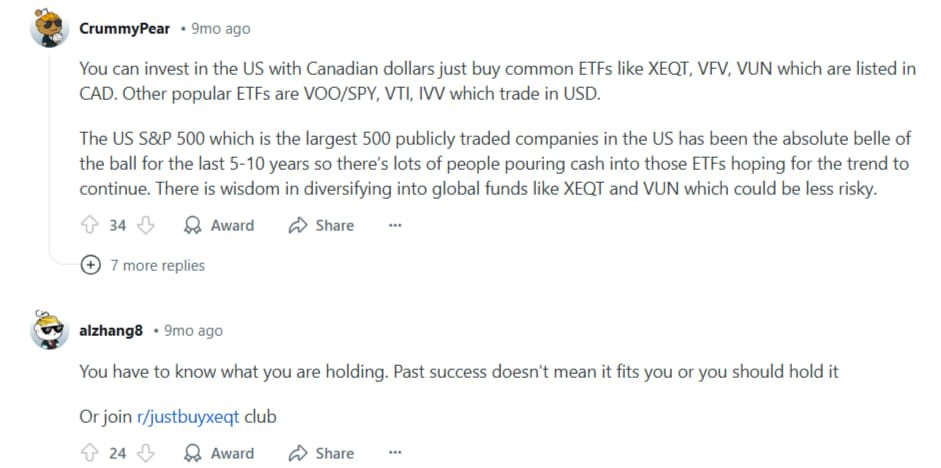
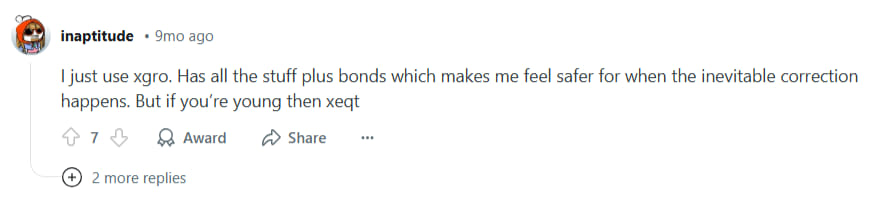
That said, there are other options that can work just as well – no stock-based investment is ever a sure bet, so it can be helpful to play the field.

Editorial Disclaimer: The content here reflects the author's opinion alone, and is not endorsed or sponsored by a bank, credit card issuer, rewards program or other entity. For complete and updated product information please visit the product issuer's website.
FAQ
What's the best ETF in Canada?
A few ETFs with the highest 1-year average annual return include VCN (21.63%), VFV, (13.78%), and VEQT (15.72%). For average annual return since inception, VFV (16.66%), XUU (12.83%), and XEQT (12.08%) are on top.
What's the best company to buy ETFs from?
Scotiabank is the best provider of ETFs in Canada. It offers a range of both index tracker EFTs and responsible investing EFTs, management fees are low, and – perhaps most importantly – Scotiabank ETFs consistently performs well.
What's an ETF?
An ETF is an exchange-traded fund, a collection of investments sold on the commodities market just like other securities – i.e., stocks, bonds, etc. There are different types of ETFs available, including both passive and actively managed options.
Should I invest in ETFs?
ETF investing is a good choice for those looking to diversify their investment risk, keep their costs low, and make long-term investments. Active traders, income investors, and hands-on investors will also appreciate the opportunities provided by ETFs.
How do I invest in ETFs?
There are three main ways to invest in an ETF in Canada: through a robo advisor, online broker, or financial advisor. Each has its own characteristics and benefits that will appeal to different types of investors.
What is the typical management expense ratio (MER) of an ETF?
The typical MER for an ETF ranges from 0.05% to 2% of the invested asset – the average MER in our table above falls at 0.25%. This is just one factor to consider when selecting investments, but it's important.
Are ETFs safer than stocks?
ETFs are less risky than stocks because they offer more diversification. While a stock represents one company, an ETF holds multiple securities. It’s like investing in the broader market instead of betting on a single company’s success.
Find more investment products
There's more to investing than just ETFs. Here are more investment products for you to consider:




Browse all products


Latest Articles in ETFs

Should you invest in the VGRO stock ETF? With an 80% bond, 20% equity approach – you're looking at decent risk for a high return. We go over...

Personal Finance
Exchange-Traded Funds, or ETFs, are investment funds that trade on stock exchanges and hold a diversified mix of assets, offering easy diver...